
SPDRRMC Holds 2nd Quarter Regular Meeting, Strengthens Disaster Resilience and Institutional Partnerships
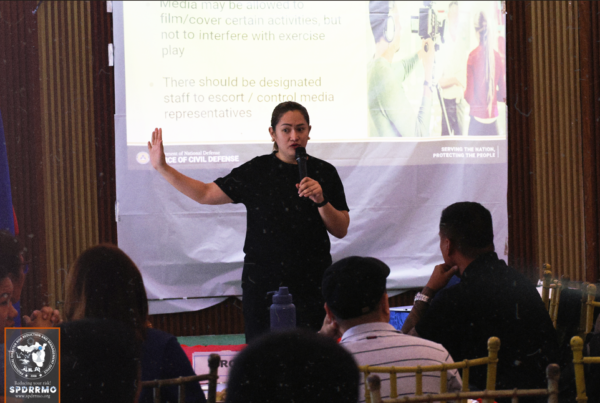
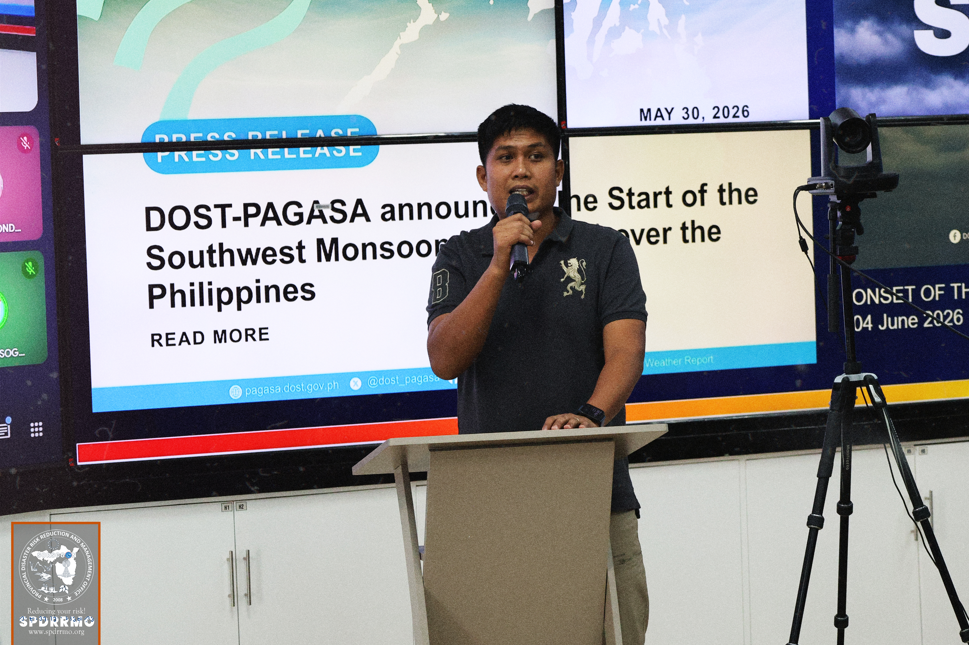
SORSOGON CITY, June 9, 2026 – The Sorsogon Provincial Disaster Risk Reduction and Management Council (SPDRRMC) successfully convened its 2nd Quarter Regular Meeting in a hybrid format at the SPDRRMO Building, Capitol Compound, Sorsogon City. The meeting was presided over by Provincial Administrator Franco Eric O. Ravanilla, representing Governor Edwin “Boboy” B. Hamor, Chairperson of the SPDRRMC. Council members, partner agencies, and stakeholders gathered to discuss key disaster risk reduction and management (DRRM) initiatives, accomplishments, emerging concerns, and strategic directions for the Province of Sorsogon.
The meeting commenced with the preliminary activities, approval of the proposed agenda, and the reading and approval of the minutes of the 1st Quarter SPDRRMC Regular Meeting. Matters arising from the previous meeting were likewise discussed to ensure the continuity of actions and commitments undertaken by the Council.
A comprehensive weather update and Mt. Bulusan status report were presented to provide council members with the latest information on prevailing weather conditions and volcanic activities. The discussion emphasized the importance of sustained monitoring, preparedness measures, and inter-agency coordination to ensure the safety of communities vulnerable to natural hazards.
One of the highlights of the meeting was the presentation of accomplishment reports from the four SPDRRMC Clusters, namely the Prevention and Mitigation Cluster, Preparedness Cluster, Rehabilitation and Recovery Cluster, and Response Cluster. The reports showcased the collective efforts of member agencies in implementing programs, projects, and activities to reduce disaster risks and strengthen community resilience throughout the province.
The Council also discussed the proposed Memorandum of Agreement (MOA) between the Provincial Government of Sorsogon and DOST-PAGASA Juban Synoptic Station, which seeks to enhance collaboration in weather monitoring, forecasting, and the dissemination of critical weather information necessary for effective disaster preparedness, response, and risk reduction initiatives.
In preparation for the Fiscal Year 2027 budget, council members were requested to submit their respective disaster risk reduction and management-related Programs, Projects, and Activities (PPAs) for possible inclusion under the 5% Local Disaster Risk Reduction and Management Fund (LDRRMF). The discussions focused on ensuring that proposed interventions align with identified hazards, community needs, and the province’s strategic DRRM priorities.
The Council was likewise informed of several significant updates and upcoming activities, including the National Disaster Risk Reduction and Management Calendar of Activities, the resumption of the Gawad Kalasag Seal Assessment, the letter of Barangay Sawanga addressed to the Department of Environment and Natural Resources (DENR), and updates regarding the accreditation of Accredited Community Disaster Volunteers (ACDVs).
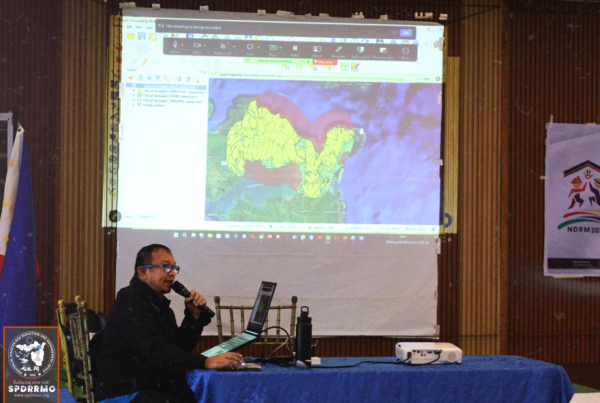
Adding significance to the gathering, the SPDRRMC warmly welcomed the delegation from Catanduanes State University (CatSU) led by Dr. Jose Z. Tria, Director / Associate Professor III, Research and Development Services (R&DS), who shared valuable insights on the university’s ongoing initiatives in disaster resilience and climate adaptation. During the meeting, Dr. Tria presented “A Multi-faceted Approach to Enhancing Flood Resilience in the Bicol Region: From Baseline Assessment to Strategic Framework Development,” highlighting the importance of science-based research, risk assessment, and collaborative planning in addressing flood-related challenges across the region.
Dr. Tria also introduced the Bicol Regional Innovation and Sustainability Empowerment for Resilience (Bicol RISER) Consortium, a collaborative platform that brings together academic institutions, government agencies, and development partners to advance innovative and sustainable solutions for disaster resilience, climate adaptation, and community development. The presentation underscored the crucial role of research institutions in generating evidence-based strategies that support local governments in enhancing disaster preparedness and reducing vulnerability to natural hazards.
The Council expressed its appreciation for the presentation and recognized the potential opportunities for collaboration between the Provincial Government of Sorsogon and Catanduanes State University in the areas of research, capacity building, knowledge-sharing, and the development of innovative approaches to disaster risk reduction and management.
Among the significant matters deliberated by the Council was the proposed Realignment of the CY 2026 Local Disaster Risk Reduction and Management Fund (LDRRMF). The discussion focused on ensuring the strategic allocation and utilization of disaster funds to address priority requirements, emerging risks, and operational needs in support of disaster preparedness, mitigation, response, and recovery efforts across the province.
Furthermore, the Council endorsed a resolution authorizing Governor Edwin “Boboy” B. Hamor, as SPDRRMC Chairperson, to enter into a Memorandum of Agreement with Catanduanes State University. The proposed partnership aims to strengthen cooperation in the fields of disaster risk reduction and management, research and development, technical assistance, capacity-building programs, academic exchanges, extension services, and other collaborative initiatives that will benefit both institutions and their respective communities.
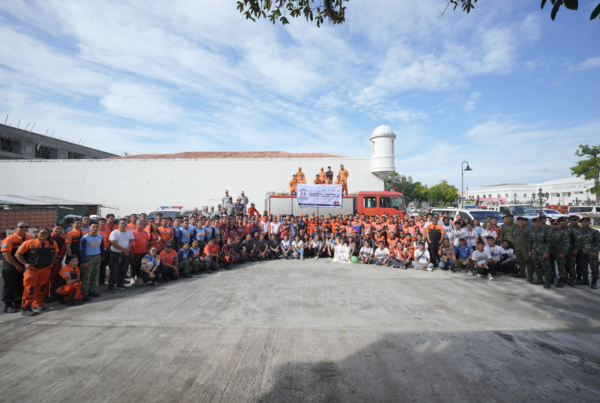
The meeting concluded with discussions on other relevant concerns and reaffirmed the commitment of all member agencies, local government units, and partner stakeholders to work collaboratively in advancing disaster resilience, enhancing preparedness capacities, and promoting the safety and well-being of every Sorsoganon.
Through sustained coordination, proactive planning, and strengthened partnerships among government agencies, academic institutions, and community stakeholders, the SPDRRMC continues to uphold its mandate of building safer, adaptive, and resilient communities capable of withstanding the challenges posed by natural and human-induced hazards.